
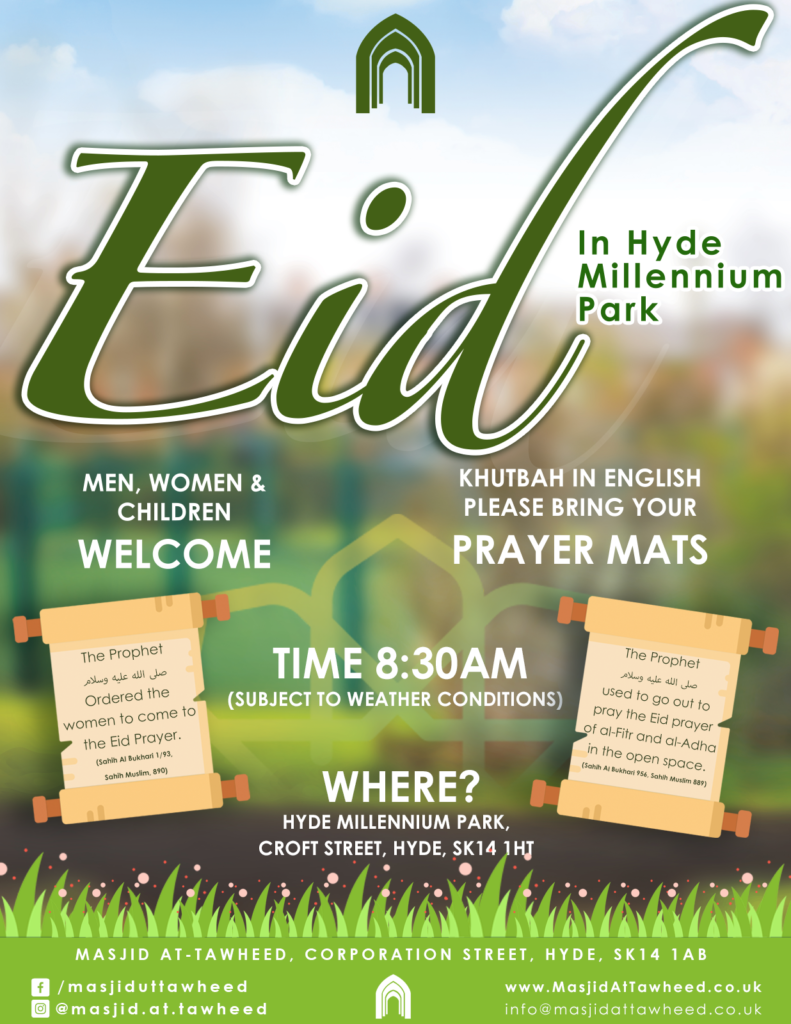

Ruling on Eid and the Sunnahs of Eid

1
It is mustahabb to recite takbeer during the night of Eid from sunset on the last day of Ramadaan until the imam comes to lead the prayer:

Men should raise their voices reciting this dhikr in the marketplaces, mosques and homes, but women should not raise their voices.

2
Some of the scholars regarded it as mustahabb to do ghusl for the Eid prayer, because it is narrated that some of the salaf did this. Doing ghusl for Eid prayer is mustahabb, just as it is prescribed for Jumu’ah because one is going to meet people. So if one does ghusl, that is good.

3
With regard to men, they should wear their best clothes – this is for men.
With regard to women, they should not wear beautiful clothes when they go out to the Eid prayer-place, because the Prophet (peace and blessings of Allaah be upon him) said: “Let them go out looking decent” i.e., in regular clothes that are not fancy.
It is haraam for them to go out wearing perfume and makeup.

4
You should eat an odd number of dates before leaving for the Eid prayer, because the Prophet (peace and blessings of Allaah be upon him) did not set out on the day of Eid until he had eaten an odd number of dates.
He should stick to an odd number as the Prophet (peace and blessings of Allaah be upon him) did.

5
It is prescribed for the one who goes out to the Eid prayer to go by one route and return by another, following the example of the Messenger of Allaah (peace and blessings of Allaah be upon him). This Sunnah does not apply to other prayers, Jumu’ah or anything else, it only applies to Eid.

6
One of the rulings on Eid prayer is that according to many scholars, if a person comes to the Eid prayer-place before the imam comes, he should sit down and not pray two rak’ahs, because the Prophet (peace and blessings of Allaah be upon him) prayed Eid with two rak’ahs, and he did not offer any prayer before or after it.

7
One of the rulings on the day of Eid – Eid al-Fitr – is that Zakaat al-Fitr is due on this day.
The Prophet (peace and blessings of Allaah be upon him) enjoined that it should be paid before the Eid prayer. It is permissible to pay it one or two days before that, because of the hadeeth of Ibn ‘Umar (may Allaah be pleased with him) which was narrated by al-Bukhaari: “They used to give it one or two days before (Eid) al-Fitr.” If it is paid after the Eid prayer, it does not count as Sadaqat al-Fitr, because of the hadeeth of Ibn ‘Abbaas: “Whoever pays it before the prayer, it is Zakaat al-Fitr, and whoever pays it after the prayer, it is ordinary charity.”
It is haraam to delay Zakaat al-Fitr until after the Eid prayer. If one delays it with no excuse then it is not acceptable zakaah, but if there is an excuse – such as if a person is traveling and does not have anything to give or anyone to give it to, or he is expecting his family to pay it and they are expecting him to pay it, then in this case he should pay it when it is easy for him to do so, even if that is after the prayer, and there is no sin on him because he has an excuse.

8
If Jumu’ah and Eid fall on the same day, the Eid prayer should be held, as should Jumu’ah prayer, as is indicated by the apparent meaning of the hadeeth of al-Nu’maan ibn Basheer which was narrated by Muslim in his Saheeh. But those who attend the Eid prayer with the imam may attend Jumu’ah if they wish, or they may pray Zuhr.